
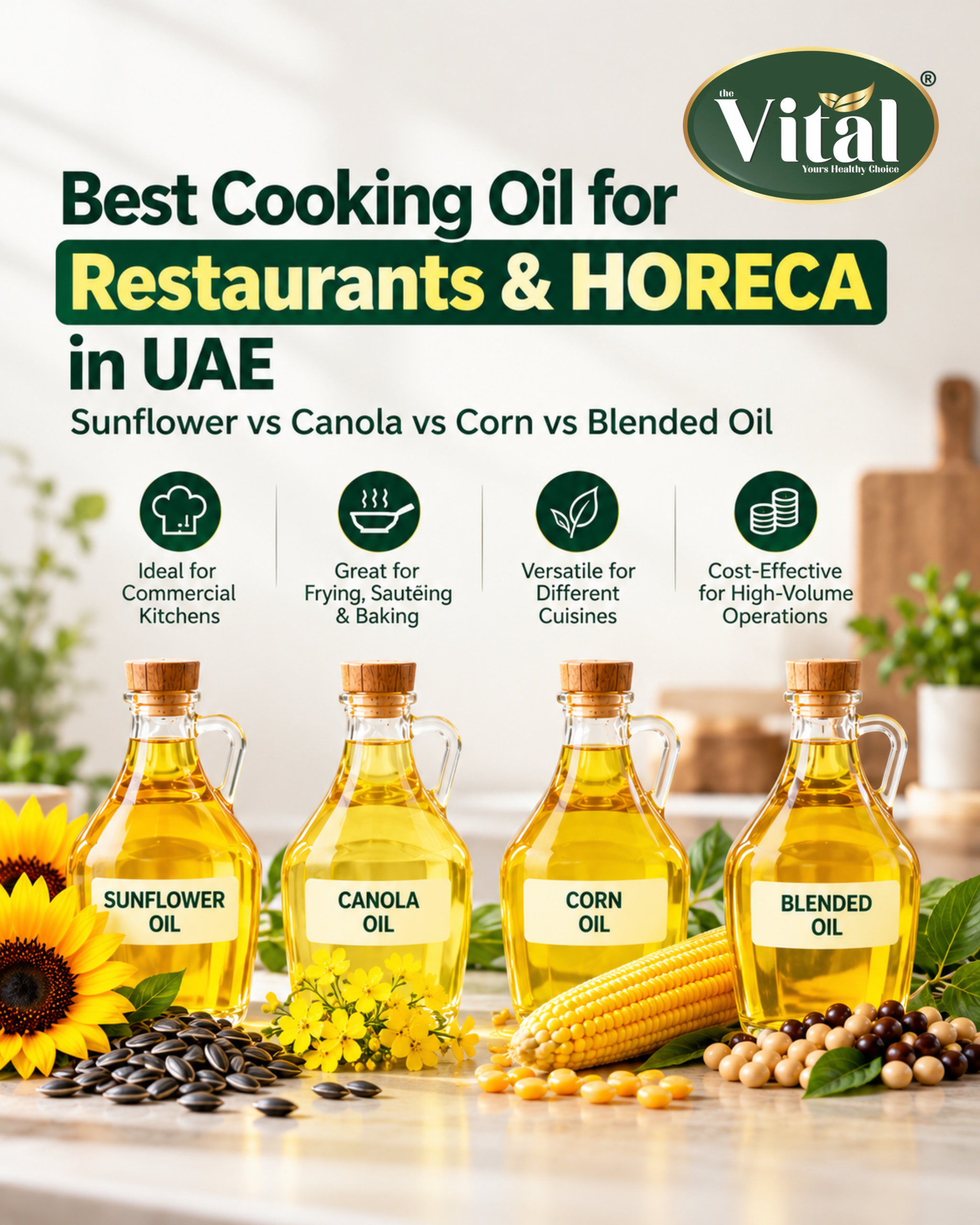
Sunflower vs Canola vs Corn vs Blended Oil
Choosing the right cooking oil is an important decision for restaurants, hotels, cafeterias, catering companies and other HORECA businesses. The oil you use can influence the taste and texture of food, cooking performance, consistency and overall kitchen costs.
With several options available, deciding between sunflower oil, canola oil, corn oil and blended vegetable oil may not always be straightforward.
As a cooking oil supplier in the UAE, Vital Foods offers edible oil solutions for foodservice, HORECA, retail and distribution businesses. In this guide, we compare four popular cooking oils to help commercial kitchens understand which option may be best suited to their requirements.
Why Choosing the Right Cooking Oil Matters for Restaurants
Restaurants and commercial kitchens use cooking oil differently from most households.
A busy kitchen may prepare hundreds of meals every day, making factors such as cooking performance, flavour, consistency, application and cost particularly important.
Before selecting an oil, HORECA buyers should consider:
Type of cooking and menu
Frying and high-temperature applications
Desired flavour profile
Volume of oil consumed
Packaging requirements
Cost per serving
Consistency of supply
Storage and handling requirements
There is no single cooking oil that is ideal for every restaurant. The best choice depends largely on what your kitchen prepares and how the oil will be used.
1. Sunflower Oil for Restaurants
Sunflower oil is one of the most widely used edible oils in professional kitchens.
Its relatively neutral flavour makes it suitable for many dishes where restaurants do not want the cooking oil to overpower the taste of other ingredients.
Where Can Restaurants Use Sunflower Oil?
Sunflower oil can be used for a variety of foodservice applications, including:
Frying
Sautéing
General cooking
Baking
Marinades
Salad dressings
Food preparation
Because of this versatility, sunflower oil can be a practical option for restaurants that prefer using one cooking oil across several menu categories.
Who Should Consider Sunflower Oil?
Sunflower oil may be suitable for:
Hotels, restaurants, cafeterias, catering companies, cloud kitchens, bakeries and other commercial food preparation businesses.
Businesses looking for a sunflower oil supplier in the UAE should also consider packaging size, expected monthly consumption and continuity of supply when selecting a supplier.
2. Canola Oil for Restaurants
Canola oil is another versatile option used by commercial kitchens.
It has a mild flavour, making it useful when chefs want the ingredients and seasonings in a dish to remain the main flavour.
Common Applications for Canola Oil
Canola oil can be used for:
Frying
Sautéing
Baking
Grilling preparation
Sauces and marinades
Salad dressings
General kitchen use
Its versatility can make canola oil useful for kitchens with diverse menus.
Sunflower Oil vs Canola Oil
For restaurants choosing between sunflower and canola oil, the decision will often depend on the recipe, desired flavour, purchasing requirements and commercial considerations.
Both can work across numerous kitchen applications.
Instead of selecting an oil based only on price, restaurants should consider how it performs in their actual cooking processes and whether the supplier can reliably meet their required volumes.
3. Corn Oil for Commercial Kitchens
Corn oil is another cooking oil commonly used across food preparation applications.
It can be useful for kitchens requiring an oil suitable for everyday cooking and frying while maintaining a relatively mild flavour.
Common Uses of Corn Oil
Restaurants and foodservice operators may use corn oil for:
Frying
Sautéing
Baking
General cooking
Food manufacturing and preparation
Corn oil may be particularly relevant to restaurants and food businesses whose existing recipes or production specifications call for it.
Who Should Consider Corn Oil?
Corn oil can be considered by restaurants, catering operations, institutional kitchens and food manufacturers looking for a versatile edible oil for commercial food preparation.
4. Blended Vegetable Oil for HORECA
For high-volume kitchens, operational efficiency and food cost are important considerations.
Blended vegetable oils combine selected edible oils to create an option designed for particular cooking and commercial requirements.
Depending on the formulation, a blended oil can provide restaurants with a practical balance between cooking performance and purchasing economics.
Why HORECA Businesses Consider Blended Oils
Commercial kitchens may consider blended oil because of:
Versatility across cooking applications
Commercial value
Suitability for high-volume operations
Consistent cooking requirements
Availability in foodservice packaging
For restaurants using large quantities of cooking oil every month, even relatively small differences in purchasing costs can become significant at scale.
Sunflower vs Canola vs Corn vs Blended Oil: Which Is Best?
There isn’t one universal answer.
The right cooking oil depends on the type of food being prepared, cooking method, required flavour profile and commercial requirements.
Sunflower Oil: A versatile choice for general cooking, frying and food preparation where a relatively neutral flavour is preferred.
Canola Oil: A mild and versatile oil suitable for multiple cooking applications.
Corn Oil: A practical option for frying, cooking and food preparation, particularly where recipes already specify corn oil.
Blended Oil: Worth considering for high-volume HORECA kitchens looking to balance cooking requirements with commercial considerations.
Restaurants can also use more than one type of oil. For example, a kitchen may choose one oil for frying and another for dressings or specific recipes.
Best Cooking Oil for Deep Frying in Restaurants
Deep frying is one of the most demanding applications for cooking oil.
Restaurants preparing French fries, fried chicken, seafood, snacks and similar products need to consider several factors when choosing frying oil.
These include:
Suitability for the intended frying temperature
Flavour impact
Consistency
Food quality requirements
Frying practices
Oil management procedures
Cost per batch
The oil itself is only part of the equation.
Proper filtration, temperature management, storage and responsible oil replacement practices can also affect frying performance and finished food quality.
Restaurants should always follow the oil manufacturer’s product specifications and their own food-safety procedures.
How Restaurants Can Reduce Cooking Oil Costs
For high-volume restaurants, cooking oil can represent a significant recurring kitchen expense.
However, choosing the cheapest oil is not necessarily the most economical strategy.
Restaurants should instead consider the total cost of use.
A foodservice business can improve oil purchasing efficiency by:
Forecasting monthly oil consumption
Purchasing appropriate HORECA pack sizes
Maintaining correct frying temperatures
Filtering frying oil where appropriate
Avoiding unnecessary contamination
Storing unopened oil correctly
Training kitchen employees in proper oil handling
Working with a reliable bulk cooking oil supplier
Good inventory planning can also reduce emergency purchases and improve consistency across multiple restaurant locations.
Buying Cooking Oil in Bulk in the UAE
Restaurants, hotels and catering companies often require larger pack sizes than households and small retailers.
When choosing a bulk cooking oil supplier in the UAE, price should not be the only consideration.
HORECA purchasing teams should evaluate:
Product Consistency
Commercial kitchens need consistent ingredients to maintain predictable food quality.
Packaging Options
Choose pack sizes that match the kitchen’s consumption and storage requirements.
Supply Reliability
Running out of a core ingredient can disrupt restaurant operations. Reliable supply is therefore particularly important for high-volume kitchens and restaurant groups.
Product Range
Working with a supplier offering multiple edible oil varieties can make purchasing easier when different restaurant concepts or menu applications require different oils.
Supplier Experience
A supplier familiar with HORECA requirements can better understand commercial quantities, packaging requirements and ongoing supply needs.
Cooking Oil for Hotels and Catering Companies
Hotels and catering companies often have different requirements from standalone restaurants.
A hotel may operate multiple kitchens, restaurants, banquet facilities and staff cafeterias from the same property.
Similarly, catering businesses may prepare hundreds or thousands of meals for events, institutions and corporate customers.
These operations can benefit from working with a HORECA cooking oil supplier in the UAE capable of supporting larger-volume requirements and different cooking applications.
Selecting the right pack size and oil type can also simplify inventory management across different kitchens.
Cooking Oil Solutions from Vital Foods
Vital Foods supplies a range of edible oils for different foodservice and commercial requirements in the UAE.
Our edible oil portfolio includes options such as:
Sunflower oil
Canola oil
Corn oil
Olive oil
Blended oils
Vital Foods serves customers across retail, foodservice and HORECA channels with different packaging requirements.
Businesses looking for a cooking oil supplier in the UAE can contact our team to discuss product options, pack sizes and commercial requirements.
Private Label Cooking Oil in the UAE
Cooking oil is not only an important category for restaurants and hotels.
Retailers, distributors and food businesses may also want to develop edible oil products under their own brands.
Vital Foods provides private label food manufacturing solutions for businesses looking to develop and expand their product portfolios.
Private label solutions can be relevant for:
Supermarkets
Food distributors
Importers and exporters
Restaurant groups
Wholesale businesses
Emerging food brands
Businesses interested in private label cooking oils can contact Vital Foods to discuss available products, packaging and manufacturing requirements.